Books for kids, teens, & those who are young at heart

Category: Writing (Page 45 of 73)

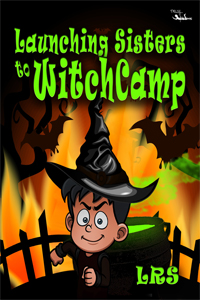
Meet LRS author of Launching Sisters to WitchCamp

I’ve got a special treat (or trick) today with LRS, author of the MG fantasy Launching Sisters to WitchCamp (see my 5-star Goodreads review here). One lucky commenter will be chosen at random to receive a free copy of the book, so make sure to say hi in the comments section (this contest in now closed and a winner has been chosen). Welcome, LRS!

Launching Sisters to WitchCamp 200x300(1)A Tale of Psychological Horrors and Reports, and Overgrown Nails

My brothers claim that growing up, I was an award-winning storyteller. They’ve never forgotten the tales I entertained them with about a quarter of a century ago.

Don’t be too impressed, my stories are not memorable for their genius; rather, I fed them psychological horrors. It’s kind of ironic, because though it took me until my thirties to author stories, I did major in psychology.

On a serious note, in a roundabout way, psychology is what led me to this childhood dream. Contrary to other psychotherapy interns, I appreciated writing client assessments. The danger of reports is that they can make the clients appear to be but a sum total of their issues; I embraced the challenge to portray my clients for who they really were as people.

It’s my work on characterization that fired up my dormant passion.  I indulged myself, and set out to write a YA series (which is a work in progress under a different pen name). As I navigate this process, I’m constantly reminded of the extent that my psychological background influences my craft. I’ll let editors do pretty much whatever   they want with my manuscripts, but I’m overprotective of my characters. For example, I’m particular that each and every piece of their dialogue should be true to them.

As a side note, I gave Launching Sisters to WitchCamp’s editor, Katie, a free hand with my characters too, as she “got” them right off the bat. I’m sure many authors can relate to the sense of pleasure / satisfaction when others grasp their characters well. To me, it’s reminiscent of the feeling mental health workers have when they sense another professional understands their client.

Launching Sisters to WitchCamp, was born during a transition period between book one and two in my YA series. I remember exactly where I was standing when the idea behind the story hit me: the bathroom sink with a nail clipper aimed at my daughter’s grotesquely long nails.

She was putting up a resistance that would impress the IRA, and I had to come up with the ultimate motivator in the few seconds I had before she’d bolt.

“If your nails get any longer, the Witches’ Camp will come for you!”

The rest is history.

Oh, and don’t worry that I’ve set out to horrify you in Launching Sisters to WitchCamp. As long as you’re no giant, goblin, or monster, you’re quite safe.

Launching Sisters to WitchCamp blurb: 

Sixth-grader J.J. learns there are no easy breaks in life.

When J.J. discovers the opportunity to send his maddening sisters off to WitchCamp, he has fantasies of a delightful summer. However, J.J. and his friend are soon off on a ride they didn’t anticipate — one that lands them in a chilling mess of witch hunts and creature feasts.

With his creative ideas, J.J. utilizes their risky escapades to escape. But making deals with superhuman creatures just lands them in hotter water.

Now it’s up to J.J. to save them all from certain death by being more imaginative and daring than ever before.

Buy the book at the MuseItUp bookstore, Amazon, Barnes & Noble, Kobo, iBooks, and other e-book retailers.

lrswithbrothersAbout the Author:

LRS has a master’s degree in psychology. For more than ten years she pretended to be working while she was on the floor enjoying playtime with kids.

She has lived on the eastern and western coasts of the U.S.A, as well as abroad, and currently resides in Canada with her family. Wherever she is, she can’t pass by a toy store without going inside.

When she’s not writing, she can usually be found in her kitchen, where she’s either baking (and sampling) cookies or stirring a pot. (Unfortunately, she has yet to find a magical spoon.)

To learn more about LRS and her book visit her website, Facebook page, or Twitter feed (@LaunchingSister).

And off to the comments for a chance to win a copy of Launching Sisters to WitchCamp!

A Room of My Own

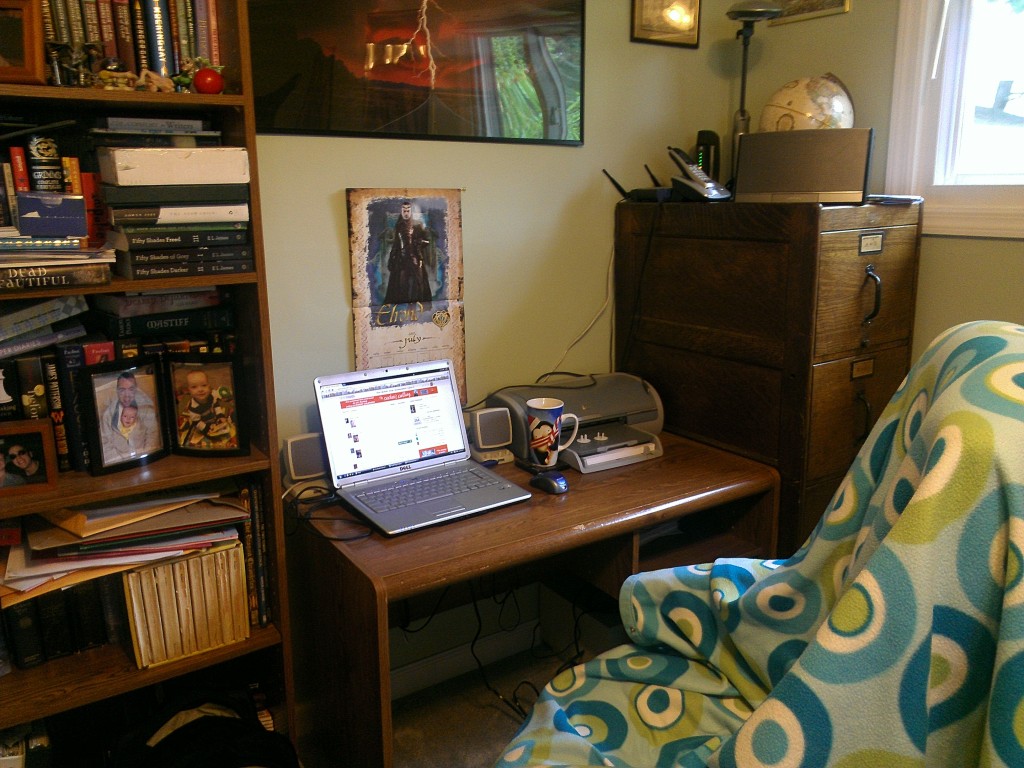
Writing Space 1My current home work space is a desk that was once my husband’s. I commandeered it when I started working from home because my desk is a lot smaller and the top of it is cluttered with papers, knickknacks, my jewelry box, and stuff. Both desks are in the room we call the library (because it has lots of bookshelves and I’ve always wanted to have a library in my house), but which also serves as the workout room (when we workout, which lately is hardly ever) and The Boy’s playroom.
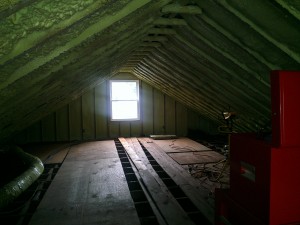
Writing Space 2In a few months, we will be switching The Boy from his current room, which is the smallest bedroom in the house, to what is now the library. And my office space will be moving upstairs to a brand-new room, which was once an unfinished attic space used only for storage and is presently in a state of partial finished.



It’s got the important stuff like heat and insulation (flooring to come soon), but I’m really excited about the big windows. For some reason when our house was built, the bedrooms all had these small windows, and even when the people who lived in the house before us redid the window, they kept them small. Like I have to stand on tiptoes to get a good look out of them. I’m not a fan.

My new desk upstairs will be right in front of one of the new big windows (the picture above doesn’t do their size justice). Admittedly, my view won’t be super picturesque or anything, mostly the street and the neighbors’ houses and lawns, but I’ll be able to see trees, too, and the sky! Sure beats staring at the wall while I write.

Granted this room won’t be entirely mine. It’ll have a big storage closet (because this was our main storage area before renovating) and an area for toys and musical instruments (which have sadly not seen the light of day for along time, and though neither my husband nor I are particularly talented in our musical pursuits, we still like to dabble). But it will be a space I helped design, with a desk that I picked out myself and didn’t just inherit. And it’s on a different floor than the rest of the house, so it will feel more like a place I can escape to write, even if The Boy ends up following me up there to bang on his piano.

Because as much as I love getting away to the cafe to write, it just doesn’t happen often enough. And as much as I’ve made do with the space I have now, it has never felt like mine. So that’s what I hope to have in this new room: a space of my own. Even if it’s just a spot on the desk in front of my big window.

What’s your favorite spot to be creative?

Dark Matter, Alternate Universes, and a Story Idea

I haven’t had a science update lately, mostly because my favorite science project the Large Hadron Collider is on hiatus. It’s being upgraded to increase its power so it can smash teeny, tiny particles even faster and harder. Scientists are hoping to unlock the secrets of dark matter.

Dark matter is thought to make up a large part of the universe, but so little is known about it. Thinking about the universe and great mysteries like dark matter get my creative juices flowing. One of my favorite science programs is Discovery Channel’s How the Universe WorksIt kind of make my head hurts because the theories and science discussed are so mind-blowing in both concept and scope, but boy it’s so exciting to think about the universe.

I took physics classes in high school and college and found them, frankly, boring. Nothing we discussed ignited any sense of excitement. I get that you have to learn the basics to better understand the bigger concepts that theoretical and astrophysicists study, but I wish those basic physics classes had at least sparked some interest in learning more. And they just didn’t do that. It wasn’t until I was an adult, long out of school, that my own curiosity lead me to a passion for learning about the universe.

I hope to one day use a fictional story to meld my passion for writing and creating worlds and characters and my excitement over the universe. It’s been percolating for some time now and I think I have a premise and a main character. But I need to finish up a couple of other projects first and school myself more on the scientific concepts I’ll need to know to make the story authentic. Anyone want to give me a crash course? 🙂

I’ll leave you with this little gem of an article called “Quantum Theory Proves That Consciousness Moves to Another Universe After Death.” It definitely sounds science-fictiony, but it’s one of those ideas that I love reading about, if only to make my head spin a little with both excitement and confusion.

Confessions of an Author: Creative Gap

Confession #7: The creative gap that exists between what an author imagines in her head and what ends up on the paper inevitably leads to a certain level of failure.

As a writer, I have certain images, ideas, nuances, themes, characters (and any number of other things) in my head when I create a piece of writing. It’s not that I necessarily have a set agenda–this is especially true when drafting and the story and characters are still taking shape–it’s more that I have a clear vision for a piece. I wouldn’t call it a message (because who wants to read a message-heavy piece of writing)…for a lack of a better way to describe it, let’s call it a creative vision.

Inevitably, the words I use to try and achieve my creative vision never quite live up to what I see in my imagination. This has nothing to with my ability as a writer; it’s more a failure of the medium of the written word. Writers have to rely on words to paint a physical and emotional landscape for a reader. We create not only worlds and characters, but ideas and feelings that need to come alive through words because a reader can’t see into a writer’s head.

Even now, trying to explain this creative gap is a frustratingly futile attempt. The words you read here are not exactly what is going on in my head. There is a creative gap between my brain and what you’re reading.

English users even try to steal words from other languages to help overcome the creative gap. A word like “umami”, taken from the Japanese, is roughly a pleasant savory taste (tomatoes are said to possess this quality), but really it’s a taste or sensation that can’t really be expressed in our language.

Then there are words that are so complex and subject to a person’s individual experiences and emotions. Success. Peace. Love. A writer can use these words, but has no control over how a reader will interpret it. Words are simply an inadequate form of communication sometimes.

And this creative gap isn’t unique to writers; it crosses all types of creative media. Films, though more visual, lack in different areas than books. When watching a film, a viewer can’t be in a character’s head and hear his/her direct thoughts (except for the occasional voice over). Artists can paint or draw what they see in their head, but there is no commentary to go with it. A person looking at a painting has to draw his/her own emotional context out of it.

So what’s a writer or creative person to do? Give up because our creative vision will never be fulfilled. Create a failure and despair over it. Nope! We accept that the creative gap exists and use all the tools we possess to convey our creative vision to the best of our ability.

Because something magical happens when our (inadequate) words are read. The creative gap works in reverse. Readers brings their own creative visions to the writer’s words. And they fill the gap, not as the writer would have filled it, but with their own imaginations.

In the end, the creative gap does not create a failure, but a piece of work that is unique to each individual who consumes it. A work that is full of images, ideas, nuances, themes, characters (and any number of things) the creator never could have imagined. And that is certainly a wonderful exchange.

The Dirt Diary Author Anna Staniszewski on Creating Diverse Characters

Let’s give a big welcome to returning guest blogger Anna Staniszewski, author of the upcoming tween book The Dirt Diary, as she discusses creating a diverse main character. I was very pleased to receive an ARC of this fabulous book and shared my thoughts on it in my 5-star Goodreads review. Welcome, Anna!

The-Dirty-Diary-Cover-w-Blurb-smallWhen I first began writing The Dirt Diary a few years ago, I knew early on that the main character, Rachel, had a white mom and a Korean-American dad. Perhaps this character detail emerged because the story took place in middle school, a time in my own life that I associate with one of my closest friends (then and now) who is Korean. Or perhaps Rachel appeared in my head that way just because that’s who she is.

For several drafts of the novel, however, I struggled with how overt I should make Rachel’s ethnicity. It didn’t play a large part in the story, but it was part of her character. Also, did I, a Polish-born, American-raised author have a right to write about a character who wasn’t like me?

As I mulled this over, I came to two realizations. First, why couldn’t Rachel’s race be part of her character without it affecting the plot? Rachel being biracial was just as much a part of her as being a girl or an only child.  It didn’t guide the story; it just felt like a natural part of her character. And second, I realized that none of the other characters I had written were “like me.” If I stuck to the “like me” criteria then I could only write about characters who had lived in Poland until they were five and then moved to New England. How boring would that be?

So I set out to write Rachel not as a biracial character but as a real character, one whose desires and emotions I could tap into and understand. I realized that my personal experiences did play a part in shaping her character. Not only do I know a thing or two about teen mortification, but having been raised bicultural made it easier for me to imagine how Rachel might feel about being biracial.

Have I made any missteps in depicting a biracial character? Perhaps. And it’s precisely that fear that kept me from acknowledging her ethnicity in early drafts of the book. Ultimately, though, I felt like it would be worse to ignore her true identity than to not try writing it at all.

The Dirt Diary blurb:

Cleaning up after the in-crowd gets Rachel all the best dirt.

Rachel can’t believe she has to give up her Saturdays to scrubbing other people’s toilets. So. Gross. But she kinda, sorta stole $287.22 from her college fund that she’s got to pay back ASAP or her mom will ground her for life. Which is even worse than working for her mother’s new cleaning business. Maybe. After all, becoming a maid is definitely not going to help her already loserish reputation.

But Rachel picks up more than smell socks on the job. As maid to some of the most popular kids in school, Rachel suddenly has all the dirt on the 8th grade in-crowd. Her formerly boring diary is now filled with juicy secrets. And when her crush offers to pay her to spy on his girlfriend, Rachel has to decide if she’s willing to get her hands dirty…

Anna_StaniszewskiAbout the Author:

Born in Poland and raised in the United States, Anna Staniszewski grew up loving stories in both Polish and English. She was named the 2006-2007 Writer-in-Residence at the Boston Public Library and a winner of the 2009 PEN New England Susan P. Bloom Discovery Award. When she’s not writing, Anna spends her time teaching, reading, and challenging unicorns to games of hopscotch. She is the author of My Very UnFairy Tale Life series, published by Sourcebooks Jabberwocky. Look for the first book in Anna’s next tween series, The Dirt Diary, in January 2014, and visit her at www.annastan.com.

« Older posts Newer posts »

© 2026 Katie L. Carroll

Theme by Anders NorenUp ↑