Books for kids, teens, & those who are young at heart

Category: Travel (Page 12 of 14)

Observations on the Train to NYC

I recently headed down to NYC for one of the SCBWI Writers of Lower Fairfield County Editor Evenings (mine is the middle grade novel…and how great is it that I’m referred to as an author?). As usual, I took the hour-and-a-half train ride into Grand Central.

I often go into the city with the girls. (Here’s a kind-of-old picture of “the girls” at the Hard Rock Cafe. I’m the cute one!)
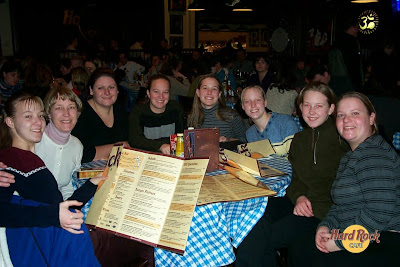
When I’m with the girls, the train rides fly by. We usually have so much catching up to do that the ride is over before we’ve run out of things to say. The focus is on us and not the world that streams past the windows.

However, I took this most recent trip alone. I brought a book, but the scenes through the glass grabbed my attention. It wasn’t the beauty of life that interested me; it was the real scenes of life that caught my imagination. I appreciate that Metro North Railroad takes a direct route from point A to point B and doesn’t try to send the train through the most picturesque areas.

My little tour of the wrong sides of the track gave me much to think and dream about. And I was able to do it from the safety of my train seat. Here are some of things I saw:

  • A beat up compact car (possibly a Hyundai Accent) sits in a parking lot behind some kind of apartment complex. It’s purple, and not a deep night-sky kind of purple, more of a dark lavender kind of purple (not my first choice for a car color). The back quarter panel on the passenger’s side is all banged up, and the back tire on that side is flat. I wonder what story that sad little car has to tell? An adventure? A tragedy?
  • A young boy hangs out with his friends at a school playground. He’s waving to the train, or maybe he’s waving at some other object in the same eye line. He’s got a big grin on his face. Is the smile sweet? Mischievous? What do his friends think of his enthusiasm?
  • Three cops cars are parked side-by-side in the back parking lot of some large store. They’re hidden from the road and no other cars are near them. What are they doing there? Slacking off? Planning some big bust?

There are so many stories being told when you take a few minutes to look out the window.

The Scale of the Universe Makes Me Feel Small

My post on the Higgs boson or God particle discussed things that are really small, so here’s some thoughts that take you to somewhere really big. These big thoughts made me feel really small and certainly gave me a totally new perspective.

A couple of years ago, I was in NYC for a writing conference. My husband came with me and we went down a day early to check out the city. We decided to visit the American Museum of Natural History. Neither of us had been there since we were kids. Actually, it was a lot more fun to go as adults. We could look at whatever we wanted (and skip anything we didn’t feel like looking at), we didn’t have to fill out any kind of worksheets or anything, and no chaperones.

There was one particular exhibit that really blew my mind, one I still think about today. The Scales of the Universe looks pretty flashy with the giant model planets that hang from the ceiling and the enormous Hayden Sphere, but the meat-and-bones of the exhibit is based on a simple power of ten scale.

The exhibits walkway starts by showing you the very small (yup, I’m talking about those good old microparticles), and each step takes you to something a little larger, and in comparison you get a little smaller, and smaller, and smaller, and smaller…And as you meander around the walkway, you learn how insignificant your life really is.

The coolest things is how the exhibit uses reference points that are easy to understand. That’s where the models and the Hayden Sphere (which in relative size to the model planets represents the sun) come into play. One step might show you a tiny speck and explain that if the Hayden Sphere were (I’m totally making up this comparison; the museum website shows you real ones) say your head, this speck might be how big a single skin cell is.

That’s how the exhibit does just what it says: it uses the large spheres and smaller models to scale the universe and its parts into a size that is comprehendible. Well, sort of. By the end of the walkway our own universe is so small in comparison to the object to which it’s being compared that you’re not even a speck within a speck within a speck…Whoa! Totally mind (well you know!).

I try to remember this scale when nine months after sending out my baby, my heart and soul on paper (a.k.a. my manuscript), I receive a brief note from an editor saying that she like my manuscript but it wasn’t right for her list. It’s all about keeping things in perspective…at least that’s what I keep telling myself!

SCBWI L.A. 2008 Conference Gems: Part 3

Okay, so here are the last few bits of wisdom I’ll share from the LA Conference:

  • The perfect ending is a surprise and is inevitable
  • Art is in the details
  • Fiction has a higher standard of believability than real life
  • Male energy is action, adventure, fun, and blowing stuff up; female energy is relationships, interaction, beauty of language, and character
  • Use male energy to make things happen and female energy to make people care

Bruce Coville (from his session “Plotting: The Architecture of Story”)

  • Try to create some semblance of order in the chaos of the world and within
  • Children are game for anything
  • Yearning is part of what defines all art
  • Use your very guts to spill out your very best

Susan Patron (from her speech “Endings: Surprising and Yet Inevitable)

Okay, that’s all I have for now. As my brother would say, “Think about it.”

SCBWI L.A. 2008 Conference Gems: Part 2

My picture made someone else’s blog! Wow, I’m almost famous! Lisa Yee is a YA author who presented at the conference. Check out the second picture on this post to see me attending her session on revision.

What you can’t find me? I’m all the way over to the right…the blonde in the bluish/green sweater…okay, so really about a quarter of me is cut off, but I’m still mostly in the picture. Well it was fun for me to see it, so I don’t care if you don’t care!

Here are a few more conference tidbits for you to ponder:

  • Everyone starts as a beginner
  • You never know what might become a masterpiece
  • Say what you mean
  • No one else knows just what you know
  • Time slips away so fast; don’t wait
  • Just because a book is a classic doesn’t mean you have to like it

Leonard Marcus (from his speech “Advice from a Legendary Editor: Ten Invaluable Lessons About Making Great Children’s Books”)

  • Imagination is more important than knowledge

Dilys Evans (from a panel discussion called “All About Agents”)

  • Take the good part and circle it, then use that as your standard; try to make everything else that good and keep working until the rest gets there

Lisa Yee (from her session “ReVision, reviSion, Revision”)

All the following are from the panel discussion called “Emerging Editorial Voices”:

  • Do something during work hours that is not related to work; you need to engage other parts of the mind

(Namrata Tripathi discussing advice from her mentor Brenda Bowen)

  • Keep working, you’re not there yet

(Gretchen Hirsch discussing advice from her mentor Allyn Johnston)

  • When you’re really upset about something ask “Is anyone going to loose an arm?” If the answer is no, then it’s okay.

(Krista Marino discussing advice from her mentor Beverly Horowitz)

Ponder away!

SCBWI L.A. 2008 Conference Gems: Part 1

I went to L.A. for a writing conference, so I basically spent four days listening to speeches and attending sessions about writing. (Fear not nonwriters–this post won’t strictly be about writing.) I took a ton of notes and observed many little gems of wisdom.

I was frantically trying to record everything, but I wasn’t quick enough to always get direct quotations. Some of these may be actual quotations, but more likely I’ve paraphrased them. Still, I’ve cited the speaker and talk in which each was written.

Here are some gems that I think not only apply to writing, but can also be useful in everyday life:

  • Open your ears, mind, and heart
  • Be bolder in what you do
  • Celebrate everyday joys
  • Joy is free
  • Celebrate laughter as the highest human action

Bruce Coville (from his speech “The Art of the Heart: Writing True for the Child”)

  • There are no rules–just whatever you are doing has to work

Mark Teague (from his speech “My 20 Years in Children’s Books: A Survivor’s Tale”)

  • You will go in the direction you are looking

Margaret Peterson Haddix (from her speech “Dig In”–this was advice from her ski instructor, which just goes to show how universal these thoughts are)

  • Stories have such power in the world, even when they’re only about the death of a certain kind of story

Arthur Levine (from his speech “Picture Books Live! An Analysis of Success”)

  • Spending a lot of money doesn’t always mean making a lot of money

Elizabeth Law (from a panel discussion called “Today in Children’s Publishing”)

These don’t even take us halfway through the conference, so I’m sure I’ll have more once I finish transcribing my notes. Besides, I think that’s enough to contemplate for one day!

« Older posts Newer posts »

© 2026 Katie L. Carroll

Theme by Anders NorenUp ↑