Books for kids, teens, & those who are young at heart

Author: Katie L. Carroll (Page 67 of 142)

Facts in Fiction with THE GREAT CT CAPER Author Laura A. Woollett

Have you read chapter 4 of The Great CT Caper yet? If not, you’ll certainly want to after getting an inside look at how chapter 4 author Laura A. Woollett conducted her research for the Caper. Welcome, Laura!
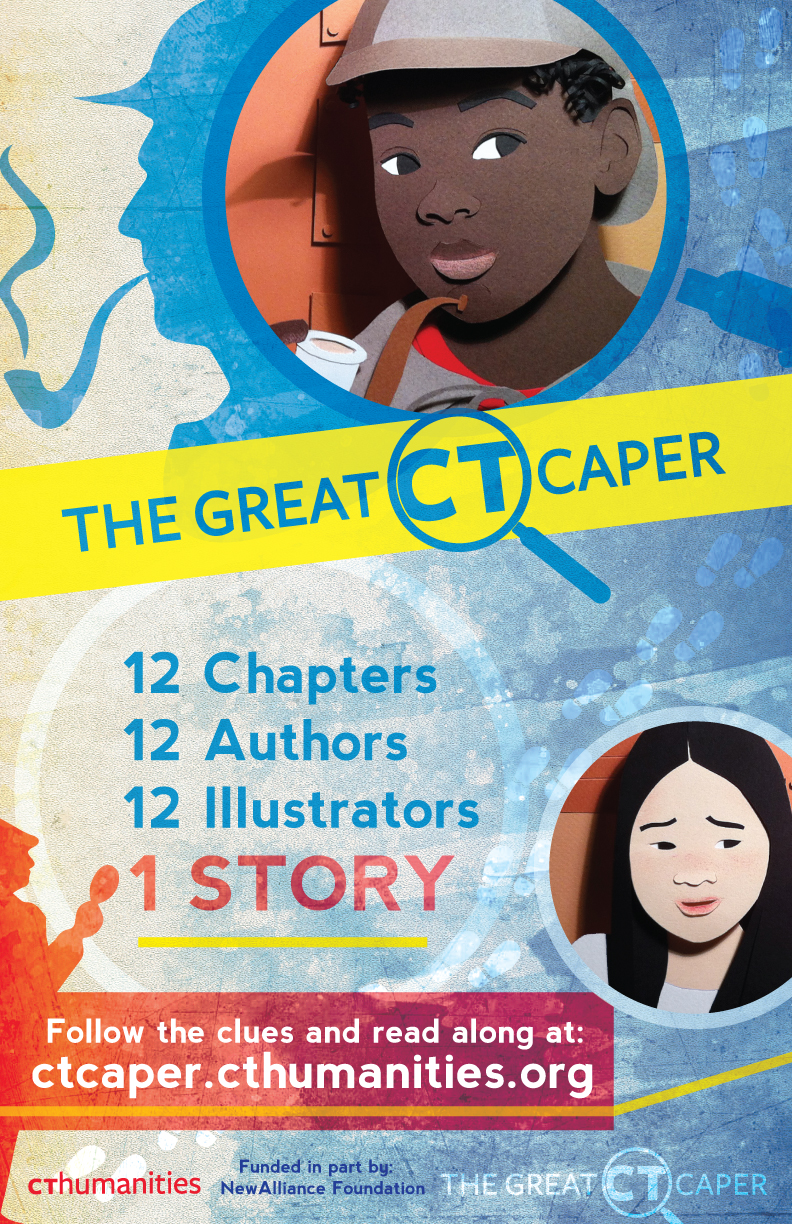
CTCaper_poster_finalFacts In Fiction

by Laura A. Woollett

I’ve been thinking a lot about how facts figure into the writing of fiction. If your fictional story is set in a real place or has real people in it, how much creative license do you have?

Research is a crucial element to creating historical fiction. The reader must feel as if he or she is IN that time and place. That means getting details such as clothing, cuisine, and architecture correct for the time period. But what about realistic fiction that takes place in the current time period? What about in a story like The Great CT Caper, which is a fictional mystery set in a real location that young readers can visit for themselves?
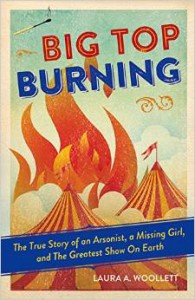
Big Top BurningMy first book, Big Top Burning: The True Story of an Arsonist, a Missing Girl, and The Greatest Show On Earth (Chicago Review Press, June 2015) is nonfiction. Every detail was meticulously researched through primary source documents. I’m accustomed to gathering facts and presenting them in an engaging story format. As I wrote my chapter for The Great CT Caper, I wondered how close I had to stick to the facts of the real-life setting.

I began thinking about this project by taking a trip Gillette’s castle. It was a beautiful, sunny September day, and flowers were still blooming. The Connecticut River rushed by far below the castle’s teeth-like walls. Inside, I passed through a secret passage and leaned over the balcony to look down on the great hall. I touched the walls covered in a woven hemp-like material and counted the Gillette_Castlemany carved wooden doors, each one unique. Fiction feels its most real when the sensory details are just right. Since our story would take place at this real location, it felt important for me to experience what Li-Ming and Thomas would first hand.

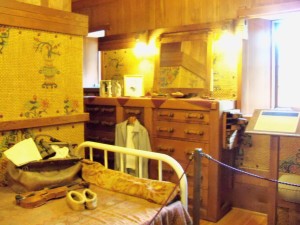
Including details from the castle was important, but I did not want my chapter to sound like a report, so stuffed with facts it would appear I were teaching kids about the castle rather than telling a story that happened to take place there. I had to pretend the castle wasn’t a real place at all, but an imagined one, and like in any well-written fiction, I would only include details that gave the essence of the setting and furthered Gillettes_Bedroomthe plot. If the detail was not important to the scene, I cut it, even if it were true. Somewhere in Chapter 4, I took a bit of artistic license. Can you tell where?
Whether writing fiction or nonfiction, writers want their scenes, their characters, and their stories to ring true. Here are my goals for any writing project:

  1. Do your due diligence.

Go online and research reputable sites that have information on the time and place where your story is set. Better still, go to a library and ask a librarian. Best case, if you’re using a real setting you don’t know much about, visit. Take notes and pictures. Talk to the experts or people living there.

  1. Be true to the time and place.

This means no anachronisms. If trolley cars had stopped running through Hartford during the time of your story, you cannot have your characters riding on them. Get the clothing right, the types of food, the music people listened to, and the world events that shaped their lives.

  1. Do your best.

In the past, I’ve wrung my stomach into knots worrying that I’ve messed up some factual detail. And in my experience, if I’m feeling this way, it means I’ve definitely done #1 and 2, so it’s time to let that worry go.

LauraAWoollett_1colorAbout the Author:

Laura A. Woollett has a Master’s degree in Children’s Literature from Simmons College and is a full-time writer and editor of literacy curriculum for children in kindergarten through grade 12. Her first book for middle-grade readers, Big Top Burning: The True Story of an Arsonist, a Missing Girl, and The Greatest Show On Earth, a nonfiction account of the 1944 Hartford circus fire, will be published by Chicago Review Press in June 2015. Laura is the author of Chapter 4 of The Great Connecticut Caper, a middle-grade serialized whodunit published online through the CT Center for the Book, January–June 2015.


“Serial Killers Are People, Too” From Author Stuart R. West

Writer friend and return guest poster Stuart R. West has a seriously deranged and hilarious post that is perfect for Friday the 13th. Stuart is celebrating the release of his latest thriller THE SECRET SOCIETY OF LIKE-MINDED INDIVIDUALS. Welcome, Stuart!

Like-Minded Individuals 200x300Serial killers are people, too.

First of all, I’d like to thank Katie for allowing me to step up on my soap-box. Look, I know I have an up-hill battle, campaigning for serial killers’ rights. But, here’s the deal. The serial killers I’ve written about in my newest book, The Secret Society of Like-Minded Individuals, are an interesting lot, people you may like to get to know. Um, just be very careful around them; hide the sharp utensils during dinner gatherings.

My protagonist, Leon, is just about the most well-adjusted, highly moral, nice-guy serial killer you’re ever gonna’ run across. (And you probably don’t wanna’ run across many of them, just saying.) He only kills those who need it, he has his reasons. Okay, okay, so he has a few issues. Still, all in all, not a bad guy.

On the other hand, we have Cody, aka “the Denver Decapitator,” Leon’s nemesis. Sure, he’s young, immature, cocky, and yanking the world by the tail. But there’s something about the guy. Something unspoken, some sort of humanity lurking beneath his rough, soul-patched veneer. He’s just got an odd way of showing it.

Let’s talk about the “Good Samaritan Killer.” Well…I really can’t without giving away spoilers. A big surprise. But they’re human, only too much so. (Wait, did I say “they?” Heh. Read the book and find out.)

“The Mad Doctor?” Such an ugly nom de plume, one he’s not fond of. After all, he kills in the name of love. Why can’t everyone just get along? It’s complicated.

Wait, look over there, it’s “Donny and Marie,” the two most charmingly psychopathic hit-men you’re ever gonna’ run across. It’s not just a job to them, we’re talking fun and games.

And fun and games is what you’re gonna’ get with The Secret Society of Like-Minded Individuals. A lot of people who’ve read it had their doubts at first, believing it might be a bit too much for their tender psyches to take. I understand. But they all agreed…they were in for a big surprise. Suspense, thrills, action, surprises–heck, even romance–and a light dusting of dark humor.

Here, author Heather Brainerd (of the exceptional Jose Picada mystery series) sums it up best: “I really, truly, and almost surprisingly loved SSLMI. I was a little scared of the whole serial-killer-as-protagonist concept, but it was awesome. Looking forward to the next one.”

See? SO, the next time you meet a serial killer (assuming you survive the encounter), just remember that they’re people, too. Shake their hand (don’t linger! And don’t look ‘em in the eye!), pat ‘em on the back, and give ‘em an “attaboy.”

Okay, maybe not, but you know what I mean.

THE SECRET SOCIETY OF LIKE-MINDED INDIVIDUALS blurb: 

Leon Garber has his reasons for ridding the world of abusive people, call it justifiable homicide.

Opportunity comes knocking from Like-Minded Individuals, Inc., a global company fulfilling the needs of people like Leon. LMI’s clientele are provided with new identities, security, and even lists of potential “projects.” But let’s not call it “serial killing.” Such a nasty business. For Leon, it’s a dream come true.

However, LMI’s put a target on Leon’s back. He has no idea why.

LMI, the police, sanctioned hitmen, and a vicious psychopath are after him. He collides with other Like-Minded Individuals: The Good Samaritan Killer, The Mad Doctor, Donnie and Marie (don’t ask). Heads are chopped, dropped and swapped as Leon fights for his life. But nothing will keep Leon from finishing his current project. Nothing. Not even the chance to fall in love with the woman of his dreams.

Sometimes a killer business idea is just that. Killer.

Amazon link: The Secret Society of Like-Minded Individuals

_MG_0556 - Version 2About the Author:

For more about Stuart check out his Amazon author page: http://www.amazon.com/Stuart-R.-West/e/B00B419X5C/ref=ntt_athr_dp_pel_1

Or his blog: http://stuartrwest.blogspot.com/

February Blues and Preview of New England SCBWI Spring Conference

The midpoint of February is just about when I’ve had enough of winter and I’m start looking pale and tragic (name that movie reference for a gold star!). I practically have to bribe The Boy to go outside and play, ya know, on the rare day when it isn’t snowing or positively frigid. It’s always at this point of the year when I question why I live in New England.

Even with all the gloomy weather, I’ve been busy prepping for a school visit for the Great CT Caper this week and a big conference appearance in April. The conference is the New England SCBWI Regional Conference and I’ll be teaching two workshops there, an hour-long one called “Something Borrowed, Something New: Mining Myths, Legends, and Fairy Tales to Write Fantasy” and a two-hour intensive called “Mapping a Scene by Scene Guide to Revision”.

And if those scintillating titles don’t make you want to go, just check out the rest of the faculty list, including Crystal Kite winner Jo Knowles, Caldecott Medal winner Dan Santat, Newberry Medal winner Kwame Alexander, and a slew of other amazing authors, illustrators, editors, and agents. As I’m writing out this list, I’m starting to have second thoughts about being on faculty. What could I possibly have to offer in comparison to these amazing talents?

*Deep breath as I attempt to avert a crisis of confidence*

Okay, fake it till I make it…. “My sessions are going to be amazing,” I say in a cheerleader type voice. I last attended this conference in 2013 (check out the highlights here), though I took last year off because I was super pregnant. Registration is open and filling up quickly (do that here!).

What have you all been up to this winter?

Meet Beth Lovell Illustrator for THE GREAT CONNECTICUT CAPER

Have you check out chapter three of THE GREAT CONNECTICUT CAPER yet? You’ll definitely want to after reading this interview to see what Beth Lovell has created as an illustration for the Caper. All the beautiful artwork on this post was graciously provided by Beth. Let’s give her a big welcome!

What is your typical approach when sitting down to start a new project?

I draw or paint every day and usually my work is completed in one fell swoop. I work anywhere from 5 minutes to an hour or longer on a particular piece, usually.

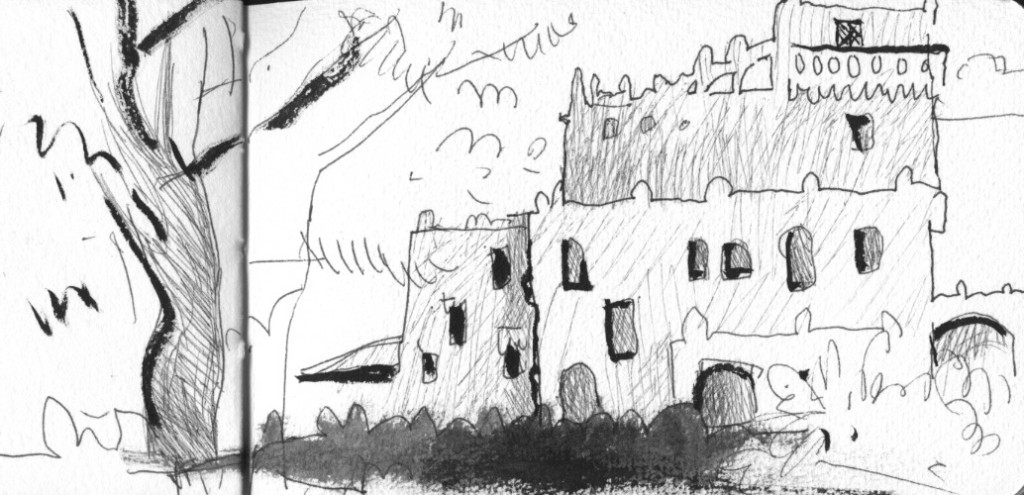
gillette sketch

Did your approach differ at all for creating your illustration for the Great CT Caper?

Yes, I did multiple sketches for the different characters imagining how they might look, and I sketched and took loads of photos on site at the locations that were mentioned in my chapter and at Gillette Castle itself. I wanted to have as many resources in my own hand as possible for completing the assignment and I prefer if possible to work from observation rather than photos. I did have to Google search for some character ideas however. I scanned all the drawings and paintings and sketches and made a collage in Photoshop laying everything out like I wanted. I printed and re-drew on the prints, and rescanned and re-collaged everything several time before I was happy with it. My husband is a Photoshop expert so he had a hand in it as well.

What was your biggest challenge for creating a piece of artwork for the Great CT Caper?

Working under the deadline of a week was exhilarating and frantic. I think artists secretly like the pressure of a deadline because it focuses you like nothing else can!

Did you do any particular research for this project?

I sketched on location at many of the parks mentioned in the chapter. It was fun to see a few places in Connecticut that I had not yet visited. Connecticut offers quite a bit of variety in terms of terrain, there is the shoreline, beaches, wooded hiking trails, really interesting and unusual architecture like Gillette Castle.

I did Google searches to come up with a couple of characters in my illustration and that was loads of fun. If you have something particular in mind when you start your image search it is fun to see how close you can get to that idea, but also there is a random element there.

Scan

How did you get started in illustrating?

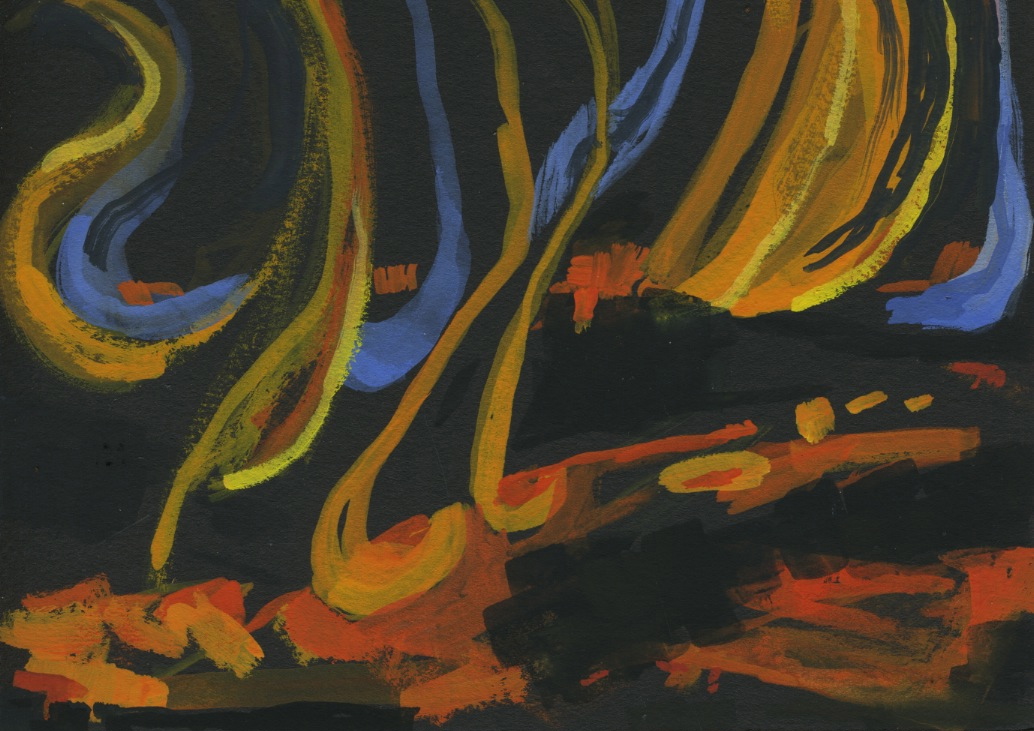
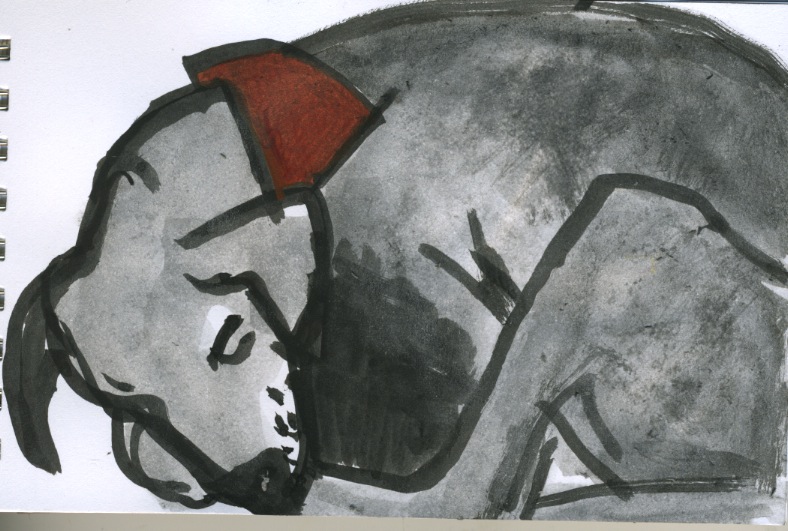
I have been doing a drawing or painting every day as challenge to keep art a significant part of my life since 2009. I was trained as an oil painter, but I seriously love drawing, it is so fun and direct, it seems so much more natural of a way of making things for me and I just cannot stop doing it. My drawings have a kind of illustrative quality so I have just been going in that direction more and more. I would love to illustrate more professionally but I have only done a few published things, if you count web venues. I would love to illustrate a graphic novel.

What is your work space like? Do you have any other places you like to work?

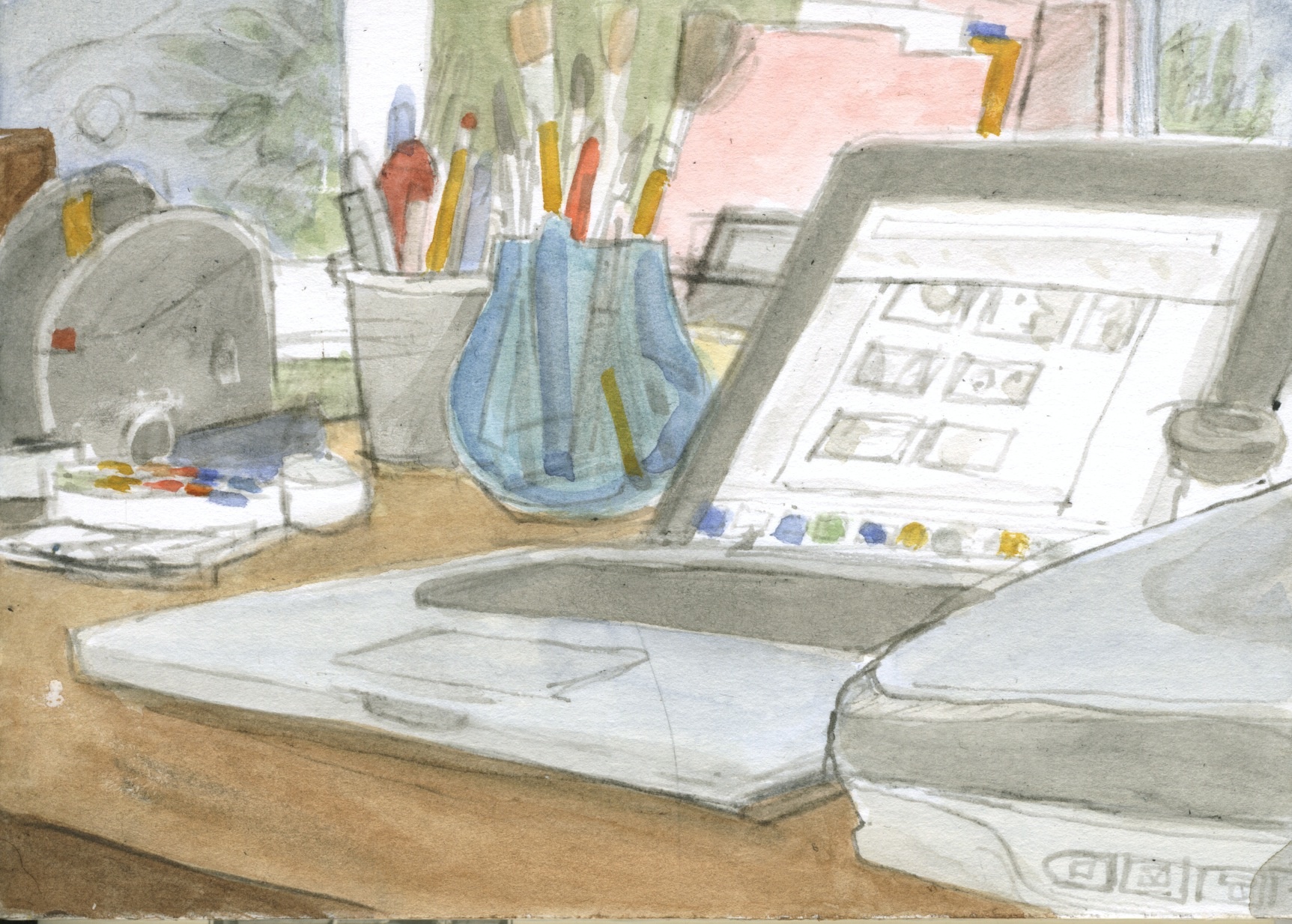
I work at home, in our dining room which has my computer desk and scanner, and a large table made from a wooden door. It is a fabulous workspace that everyone in the family uses for various projects, homework, and whatnot.

I also have a small field kit of art supplies that travel with me at all times so I can sketch in the supermarket, or out and about whenever I see something that is visually interesting. I love sketching on location and have drawn many times at the Peabody, and coffee shops, and the New Haven green and around.

workspace

What artists inspire you?

This is a big question, and for this interview, I will focus just on illustrators. Before I had children, most of my influences were people who made paintings, but since my kids were little I have just gone mad for children’s book illustrators, cartoonists, and people who make graphic novels. A few who I admire greatly are Mimi Grey whose collaged children’s books are just fabulous and funny she did Traction Man, Kate Beaton who draws Hark a Vagrant, Lucy Knisley whose graphic novel Relish is just fabulous, and Isabel Greenberg who drew Encyclopedia of Early Earth.

Besides chapter three of the Great CT Caper, where else might people find your work?

I have work at www.bethlovell.com. I have a Facebook group for anyone who’d like to share their own daily drawings. https://www.facebook.com/groups/cawdailydrawing/

It goes along with a course I am teaching at Creative Arts Workshop in New Haven, but the Facebook group is open to anyone to join. The more the merrier!

daily drawing 4

Any upcoming projects you’d like to mention?

I recently had some sketches of Occupy New Haven in the CT Bound flatfile show at Artspace, which is a small show accompanying the CT(un)bound Book Art show going on there right now. The show was up through January 31st.  http://artspacenh.org/include/404.asp?404;https://artspacenh.org:443/galleries/gallery5/

And finally, please share something silly/unusual/interesting that you don’t normally share in interviews…

This does not really fit your question, but here goes:

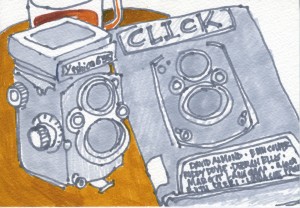
One of my favorite young adult novels is serially written collaboratively by a bunch of different fabulous authors, it is called Click! and it includes Nick Hornby (Author), David Almond (Author), Eoin Colfer (Author), Roddy Doyle (Author), Deborah Ellis (Author), Margo Langan (Author), Gregory Maguire (Author), Ruth Ozeki (Author), Linda Sue Park (Author), Tim Wynne-Jones (Author).

click

So when I heard about the collaborative  CT Caper project, I really wanted to try for it. I was so excited to be chosen as one of the illustrators on this project. I’ve always wanted to work on a graphic novel so this seemed like a good step in that direction.

The thing I want to say is that my sketch that I submitted was really sketchy and fast and I had wanted to make a whole perfect ink drawing or graphic novel spread out of it, but procrastinating artist that I was, the deadline approached, and I had to decide if I thought my sketch was good enough to submit. In my heart of hearts I knew I could do better, but in my heart of hearts I knew I also really really wanted to participate so at 11:45 pm I uploaded what I had and I am so glad I did. I want to share that with any and all artists, writers and students, go ahead and try, please don’t wait til you feel like everything is perfect, you are good enough exactly as you are, right this minute!

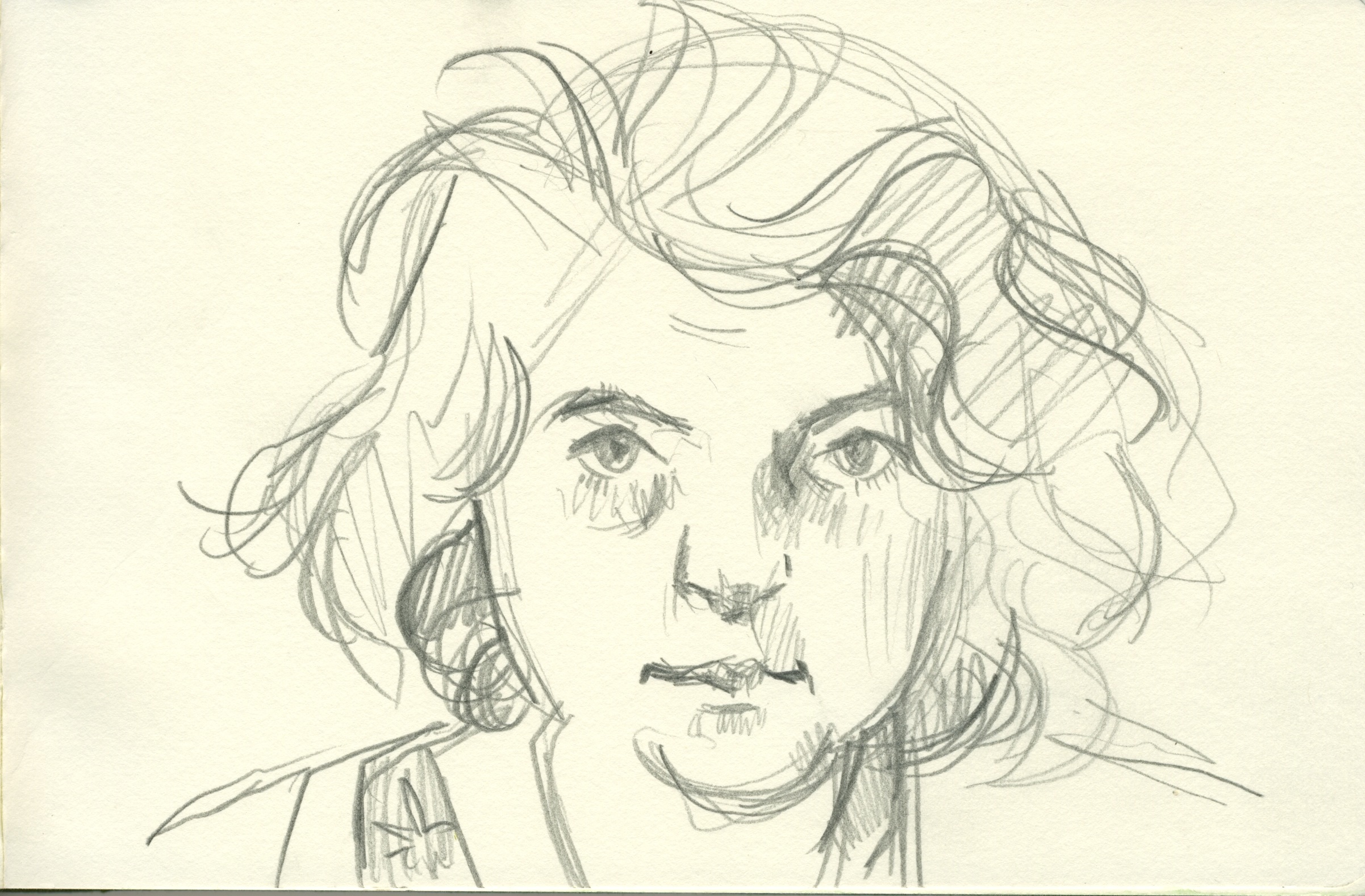
selfportrait with messy hairAbout the Illustrator:

Beth Lovell is a Connecticut artist who has posted a daily drawing or painting online since 2009, a practice that began as a New Year’s Resolution. Beth has an MFA in Painting from Yale School of Art and a BFA from Indiana University, Bloomington. You can find her work at www.bethlovell.com and littlewolfpress.etsy.com.

Females in YA: Part 9 Feminism

Somewhere along the line the word “feminist” got a bad rap, so much so that people seem to be confused about what it really means to be a feminist. Feminism is simply the doctrine advocating social, political, and all other rights of women equal to those of men”. So if you think women should have equal rights as men, then you’re a feminist. No man-hating or bra burning required!

When the heck did feminism become a bad thing anyway? Turns out a simple Internet search turns up plenty of discussion on that topic already. See “When Did Feminism Become a Bad Thing?” by Daisy Lindlar; “Why men have a problem with the word ‘feminism'” by Martin Daubney; and “Feminism: Has it Become a Dirty Word?” by Barbara & Shannon Kelley…just to name a few.

The idea of feminism has been so construed to some kind of men vs. women mantra that even these 10 really famous women celebrities (including Madonna and Susan Sarandon) have come out and said point-blank that they are not feminists. Many of whom go out of their way to say they are “humanist” (whatever the hell that means…can anyone who isn’t a sociopath not be a humanist?), but I suspect that they are actually feminists and are simply under the delusion that feminism is a bad thing. There’s even a hashtag on Twitter #womenagainstfeminism. Really?

C’mon, ladies, let’s get our shite together and take back the word. (Initially I wrote “our word” but changed it because men can be and should be feminists, too.) Still not convinced you’re a feminist? Check out the article “Not Sure What Feminism Is? Allow These Famous Authors To Explain” by Maddie Crum. Even as I write this rally cry, it seems someone may have beaten me to the punch.

In September 2014, UN Women Goodwill Ambassador Emma Watson made a speech about gender equality (i.e. feminism) and launched the HeForShe campaign. Among the things she said about was this:

I decided I was a feminist and this seemed uncomplicated to me. But my recent research has shown me that feminism has become an unpopular word.

Apparently I am among the ranks of women whose expressions are seen as too strong, too aggressive, isolating, anti-men and, unattractive.

Why is the word such an uncomfortable one?”

After this speech, Watson faced both praise and criticism (see the article “Emma Watson’s UN speech: what our reaction says about feminism” by Michelle Smith), and also threats to release nude photos–which didn’t actually exist–of Watson (see “The Emma Watson Threats Were A Hoax, But Women Face Similar Intimidation Online Every Day” by Emma Gray). In my mind, it was yet one more thing to confirm that we do need feminism and that we need to show what being a feminist really is.

So by now you’re probably asking, “Ummmm, Katie, when are we going to get to the part about YA?” Patience, dearies, and you shall be rewarded! Before we get to the YA part, let me point you to one more article, “Teen spirit: young feminist heroes” by Kira Cochrane, showcasing real, non-celebrity young people and their insights on feminism.

Okay, so now we’ve finally reached the YA part of all this. Writers of YA have a huge impact on the lives of teenagers. We can take our own messages of feminism and weave them into our narratives (in a non-didactic way of course). And I, for one, think we not only can, but we should. Let’s not pretend that gender inequality hasn’t infiltrated not only the fictional world of YA but also the real world in which women and men writers are treated differently (see “A Censored History of Ladies in YA Fiction” by Kelly Jensen).

Will feminism be a central issue in every piece we write? Certainly not. But even when we write about something else, like first love or a daring adventure, I think it’s important to understand what messages, even indirectly, we are sending to our readers. Is every character we are going to write be a feminist? Again, of course not. But it’s important to examine our work and wonder if in it we are buying into and maybe even feeding into gender inequality. Let’s not pigeonhole our characters, thereby not pigeonholing our teen readers.

And just in case I haven’t given you enough reading to do already with all those links, here are a few more that make me hopeful for the idea of feminism in YA: “13 Contemporary Novels All Feminists Should Read” by Emma Cueto, “13 Female Young Adult Fiction Authors That Owned 2014” by Caitlin White, and “2015 Is the Year of the Feminist YA Novel” by Kelly Jensen.

Finally, let me state for the record that I, Katie Carroll, YA author, am a feminist.

« Older posts Newer posts »

© 2026 Katie L. Carroll

Theme by Anders NorenUp ↑