Books for kids, teens, & those who are young at heart

Author: Katie L. Carroll (Page 64 of 142)

Libraries Need Your Help

I’m afraid I have another dire post about the budget cuts in my home state of Connecticut. This time we’re talking about library funding being cut. Fellow writer and library patron Patrick Scalisi has put together this post to show what’s at stake and how you can help.

Connecticut libraries need your help

Have you borrowed a book, movie or audiobook from your local library in the past year? Have you requested a book from another library or used your card at a library outside of your hometown?

If so — or if you simply believe that a healthy library system is essential to the wellbeing of Connecticut residents — then now is the time to act.

Gov. Dannel P. Malloy’s next biennial budget, which takes effect July 1 and is currently being reviewed by Connecticut’s General Assembly, cuts $3.5 million dollars from the State Library System.

Specifically, the governor’s budget proposes to eliminate funding for the ConnectiCard system, which allows Connecticut residents to use their library cards at any library in the state, and cripple the ConnectiCard system, which facilitates interlibrary loans. Legislation has also been introduced that would repeal the statutes that authorize these programs.

To put things into perspective, the Wallingford Public Library has produced a great video explaining how this will affect ALL libraries across the state and ALL Connecticut residents.

The last time cuts like this were proposed was in 2009 under Gov. M. Jodi Rell. At the time, library staff members from across the state stood arm in arm with concerned citizens to have the funding restored.

This needs to happen again.

The Connecticut Library Association has made it easy (click HERE) to find and contact your elected representatives. The organization’s advocacy page also has downloadable resources, FAQs and talking points. Among the most important are:

* CT residents will no longer be able to borrow from any public library in the state

* Libraries will have to shut their doors to their neighbors

* Taxpayers lose due to ConnectiCard cuts. They saved $68 million in 2014 by borrowing and not buying 4.5 million items

* Cutting these funds hurts the people who need their libraries the most — CT residents who live in urban areas

* This funding helps libraries, already under financial strain, to continue to provide important literacy services (reading, financial and digital), access to government services and much more

* It will be near impossible to re-establish critical public library statutes once they are eliminated

It is urgent that you contact your elected representatives today and ask that funding for Connecticut libraries be restored and maintained. Let’s not lose one of Connecticut’s most precious and important literacy and educational resources.

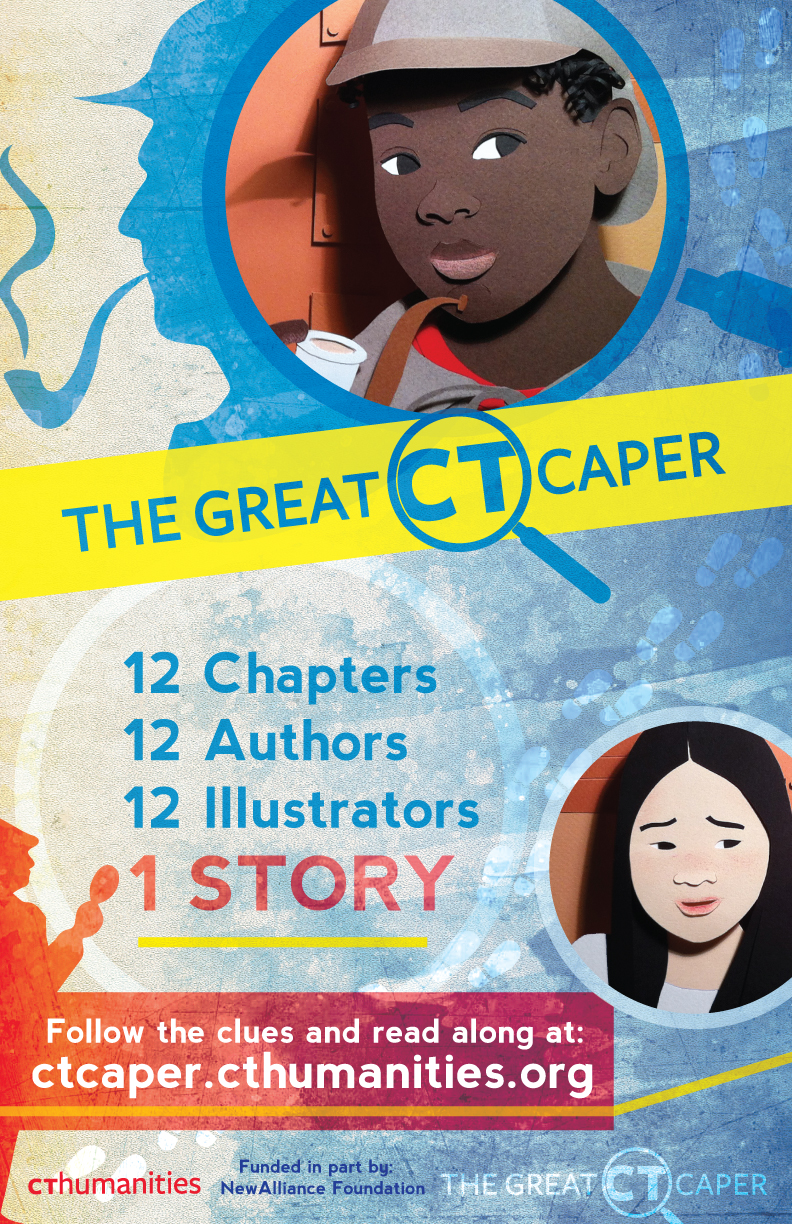
Playing Catch Up Jessica McCadden Author of Chapter 8 of THE GREAT CT CAPER

Chapter 8 of THE GREAT CONNECTICUT CAPER is here! The adventure is really shaking and moving, and with only four chapters left, I can’t wait to see what happens next. While we all wait for find out what exactly is going on with Gillette Castle, let’s give a big welcome to chapter 8 author Jessica McCadden!

CTCaper_poster_finalPlaying Catch Up

by Jessica McCadden

From the moment my wonderful mentor, Sarah Darer Littman, brought this project to my attention I wanted to be a part of it.

As a graduate student pursuing my MFA in Creative Writing, I spend a lot of time reading, writing papers, and working on my young adult novel and though I work with wonderful writers and teachers, I’m always the sole author of my projects. One of the reasons the CT Caper was so intriguing to me was because I was excited about the prospect of creating a story that would be part of a larger work. The really cool thing was that the story would be a mystery not only to the readers, but to me—one of the authors! Participating in this process meant relinquishing some creative control, but was also freeing. I didn’t have to come up with a beginning or end—I just got to focus on my one small part of the story.

Since I was writing Chapter 8, I received the first seven chapters before writing my section. The main characters had been fleshed out, and the basic themes and plot already constructed. I will admit, before even starting to think about my chapter I had to map out what was going on. There were a lot of little details to keep track of, and the most important thing was to make sure I knew where each character was at the end of chapter 7 so that my chapter would be consistent with the events that took place before. This was very different from my solo projects because instead of planning the story from beginning to end, I was playing catch up. Once I was clear on what was going on, I wrote an outline for my chapter and figured out what Connecticut landmark I wanted to include, as well as which facts about William Gillette and Gillette Castle would fit into my story.

I was happy that I could include magic into my chapter because this fantasy world had already been established. My own novel and short stories are usually in the dystopian, science fiction, or fantasy genres, so it was fun to incorporate some of the elements I love to write in Chapter 8. I also wanted to add a landmark from the part of the state where I’ve spent most of my life (southwestern CT), so I did some research and found a historical mansion just a few miles from my old home that I included in the story.

As some of the other writers have mentioned, it was really difficult to stick to the word count! I think my first draft was over 900 words long, and I’d thought I was being frugal! Cutting the chapter down to 650 words took longer than writing the original draft. After some help from the project’s wonderful editor I made revisions and was very happy with the final draft—especially the cliffhanger at the end of my chapter!

Now that my part is finished I’m concentrating on school (pursuing my MFA in Creative and Professional Writing at Western Connecticut State University) and finishing my young adult novel. My goal is to finish the final draft by early next year and after that I will be seeking representation. In the meantime, I teach college English courses and lead creative writing workshops at Writopia Lab, which gives me the opportunity to help amazing and talented kids write their own stories.

I am so grateful for this opportunity to be a part of a unique, history-mystery for children that is educational and fun to read. I’m ready to write another chapter… sequel anyone?

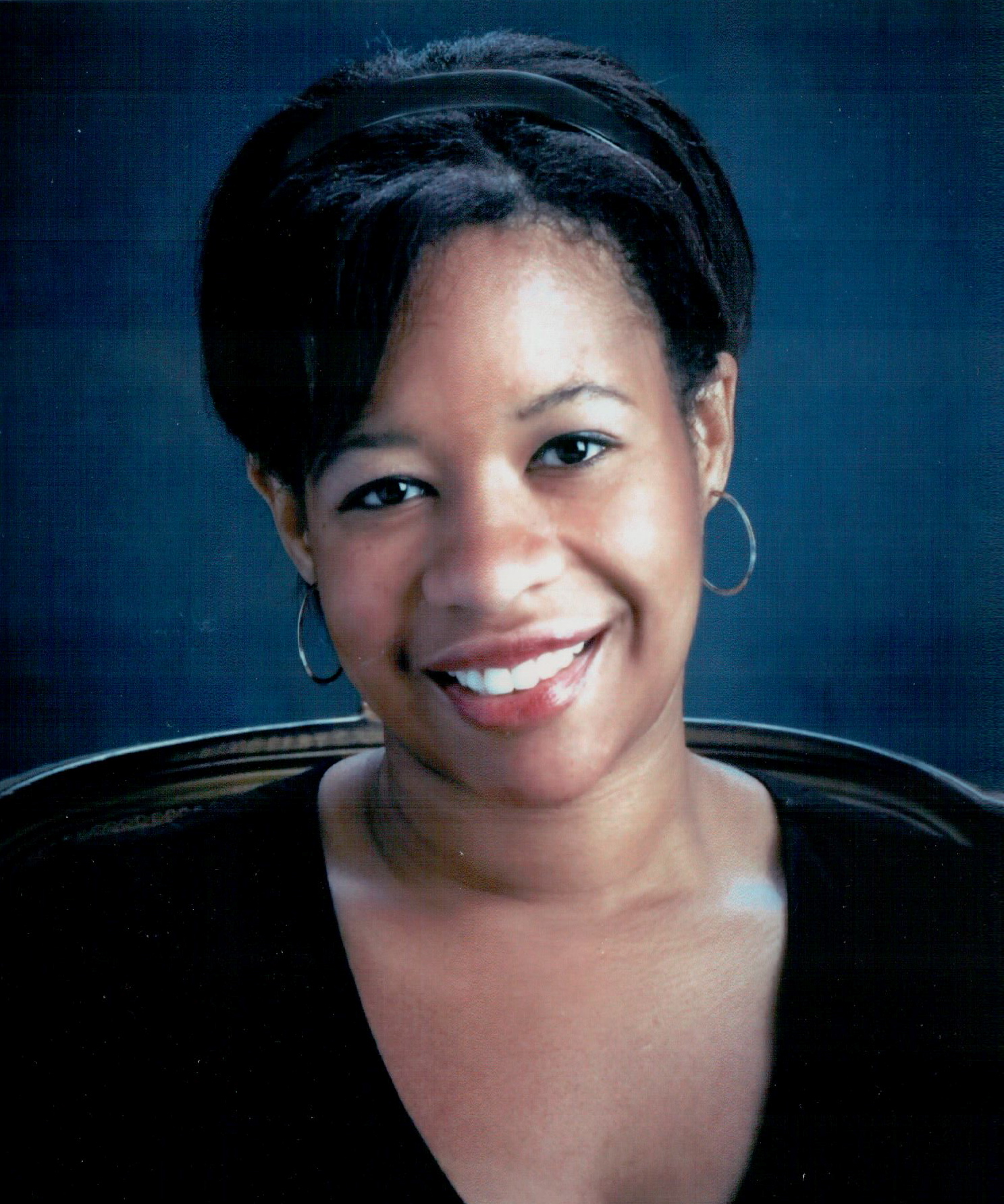
PDI_0096About the Author:

Jessica McCadden is a freelance writer who received her B.S. from Boston University and has worked as a writer and producer at NBC, Nickelodeon, and TV Land. In addition, Jessica is in the process of earning her MFA in Creative & Professional Writing with an emphasis on Young Adult fiction from Western Connecticut State University.

Jessica teaches English Literature as a graduate assistant, has led creative writing workshops for kids at Writopia Lab, worked as an editorial intern at Talcott Notch Literary Services, and is one of the authors of The Great CT Caper, a serialized mystery story for young people.

One of her goals as a writer is to increase diversity in children’s literature. She currently resides in Connecticut and is writing her first YA novel.

Connect with Jessica on LinkedIn, her website, and Twitter (@JessicaMcCadden).

Spotlight on THE EXTRACTION LIST by Renee N. Meland

While I’m away on vacation this week, I’m turning the spotlight on Renee N. Meland and her newly released YA dystopian THE EXTRACTION LIST. Welcome, Renee!
front extraction cover webTHE EXTRACTION LIST

by Renee N. Meland

When fifteen-year-old Riley Crane finds out her best friend Olivia is being abused at home, she knows just who to turn to: her mother Claire, writer and spokesperson for President Gray’s Parental Morality Law. Under this law, Task Force Officers remove children from their homes if their parents do not meet certain guidelines, taking them to government-run boarding schools. Once they arrive, supervisors rehabilitate them, turning them into productive members of society. Or at least that was how it was supposed to work…

Now, after a government official threatens to make Riley the law’s latest victim, Riley and Claire must rely on Cain Foley, a gifted killer with a tongue as sharp as the knives he carries, to get them out of America alive. Though he slices through men’s necks as if they are warm butter, Riley can’t seem to keep her cheeks from flushing every time he speaks. But when they stumble upon a deserted boarding school, Riley sees that escaping the country is only part of their problem. Together, Riley and Cain figure out that a killer can save a life, and a mother can damn a nation.

Find it on Amazon: http://www.amazon.com/Extraction-List-Renee-N-Meland-ebook/dp/B00V8KADEY

0414ReneeMeland0028About the Author:

Renee N. Meland lives in the Pacific Northwest with her husband and two dogs. Her favorite obsessions are Rome, learning new recipes, and exploring the world around her. She is an avid reader of speculative fiction, and believes that telling stories is the best job in the world.

For more about Renee visit her website, Twitter (@reneenmeland), Goodreads, and Facebook.

THE EXTRACTION LIST excerpt:

Sometimes a killer can save a life. In this case that life happened to be mine. I wish I had met him before the whole mess started. Maybe he could have saved more of us.

Maybe he could have saved us all.

I met the man who saved my life exactly one month after he killed his twentieth person. Of course he didn’t call it “murder,” he called it surviving, though sometimes I thought he should try to explain the difference to the people buried in the ground. To me, one label didn’t necessarily cancel out the other.

***

One of my teachers used to say the road to hell is paved with good intentions. Trust me, I knew all about it; I called that road “mother.” That teacher never mentioned what the road back was made with. I figured it was because nobody’d ever found one. Hell sort of struck me as a one-way-ticket kind of thing.

The night the Taskforce showed up on our doorstep, my mom screamed. After my brother Aidan’s death, then Dad leaving, hearing her carrying on like a crazy person wasn’t exactly new and different. I didn’t even flinch at first. I figured maybe she was missing my dad all the way to the bottom of a tequila bottle—again.

After a couple minutes though I slammed my copy of Crime and Punishment shut and left my room. I took my sweet time going downstairs to see her, hoping to hold on to the little bit of normal I’d had just seconds earlier. I stopped by the bathroom and grabbed a giant bottle of aspirin. Just in case.

Then I decided I was kidding myself. I knew better. There was no way she wouldn’t need aspirin.

“Riley! Get your stuff! We have to leave right now!” I ducked as Mom greeted me with a scene full of flying paper, jackets, and a few photo albums. They seemed to spin like a paper and plastic tornado, twirling through the air and landing unevenly in a giant duffel bag spread open at her feet. Even in the chaos I paused for a second to wonder how Mom’s hair managed to stay fastened perfectly in place. The image in front of me looked almost ordinary, a beautiful blonde woman in a fitted black skirt, white blouse, and hair pinned back in a bun, with a briefcase resting just inside the door.

Except this woman had thrown half our living room into orbit.

“Mom, what’s going on? What happened?”

Mom grabbed me by the shoulders and stared right into my eyes. “We need to leave right now, okay? I need you to not ask questions and just go pack a bag. You need to just trust me and do what I tell you, okay? And do NOT come downstairs until I say so.” Mom didn’t blink. I remembered the last time she didn’t blink during a whole conversation: When she told me that she and Dad needed to “work on their communication.” I found out later that was Mom-speak for “Dad’s about to abandon us and slam the door for the last time.”

I suddenly wished for the empty tequila bottle.

“You are my life.” Mom kissed my forehead, and I ran up the stairs. I didn’t come down again until I heard the gunshots. At fifteen, I was all too familiar with the sound. A person was never too young to know the snap of a gun anymore. But it was different coming from our house, like a firecracker going off inside my brain.

When I got to the entryway, a pool of blood belonging to a man in a gray suit tried to hold my shoes to the floor. The sticky mess grabbed the soles of my sneakers and smelled like raw steak fresh out of the plastic wrap. I winced as I stepped through it toward my mom. A pink piece of paper rested on top of the pool, slowly flooding with the dark red liquid. Bo, my mom’s best friend, had appeared too. Pistol smoke swirled gently from the tip of his weapon.

It wasn’t the blood, but the paper that made me scream. I felt the color drain from my cheeks, and I wondered if I looked as white as the dead man lying on our floor. “What the hell is going on? Is that pink paper what I think it is?”

Mom ignored my question. I hated being ignored more than anything, especially by her. But since there was a dead body involved, I figured I’d make an exception.

“Oh my GOD—you KILLED him!” Mom screamed, and in all her stick-thin glory started flailing her arms, hitting Bo with the strength of a flightless bird. Her bony fists bounced off his body as if his chest were made of rubber. If it hadn’t been a murder scene, it would have been kind of funny.

“Are you SURE? I saw him push you and I panicked. Maybe he’s just wounded.”

Thank God Bo didn’t panic more often.

Mom took a deep breath and stepped through the blood. She gently picked up the man’s hand and placed two fingers on his wrist. When she released it, her fingertips were stained red. “Yes. He’s dead.” She made a grand gesture, starting at his head and finishing toward his feet. “That’s what dead people look like. What are we going to do?”

My hands shook, partially from fright and partially because no one would tell me why there was a dead guy in the entryway.

Or why he had the pink slip of paper.

Bo grabbed Mom by the shoulders and held her still. “Claire, we’re going to grab Riley and we’re going to get out of here before more people come looking for this guy. I’ll tell you the plan on the way.”

Mom scoffed at him with wide eyes. “Plan? I don’t need your plan. I’m going to go straight to President Gray about this and he’s going to fix it. He has to.”

A twinge of hope rose inside me, working its way up from the tips of my toes to the top of my head. Maybe we wouldn’t have to leave our home after all. Maybe our little visit was just a really complicated, really messy misunderstanding. “Yeah, Mom’s right. I’m sure he’ll fix this. I can’t actually be on the Extraction List, right, Mom?”

“Of course not. There’s no way.”

Mom started toward the door, but Bo stepped in front of her.

“Claire, you saw the paperwork with your own eyes. Gray knows all about this. His signature is there.” He pointed to the guy on the floor. “This guy was going to grab your daughter. We need to go right now.” Bo took Mom by the hand and dragged her out the door.

I hesitated, frozen in the growing pool of red. Sweat broke out on my forehead, and it wasn’t because of the crippling D.C. heat. If I was on the Extraction List, I was supposed to end up like all those other people from my class, the ones who the Taskforce grabbed right from their desks. Those were the ones who disappeared. Since Mom had written the law that the Taskforce was responsible for enforcing, I never thought that I would ever be a target. Politics was all about protecting its stars, and there was no bigger star than my mother.

But that little pink piece of paper could only mean one thing. I forced myself to look down at it. I searched the document, eyes falling on the bottom right corner. It was faded, stretched by the blood into an unnatural shape, but it was there—the President of the United States’ signature.

I grabbed the bag Mom had been trying to pack and zipped it shut. I swung my own bag over my shoulder and followed Mom and Bo out of our house, hoping that I would someday be able to come back. But deep down, I knew we were about to drive away forever.
Books Are Not Precious

I never highlight, make notes, or otherwise intentionally mark the pages of my books. Even when I was in college and purchased text books, I never like to take notes in the pages. Books are sacred, precious, not to be marred.

Then I had kids. And if I’ve learned anything from my boys, it’s that my world view is often flawed and certainly not absolute. To kids and babies, books are more than the words and pictures in their pages. They are teethers, drums, they can be stacked to make a tower or stairs.

Not that I don’t discourage them from doing all these things; we try to teach the boys to take care of their belongings. But that doesn’t mean they revere books in the way I do. To them, books are not sacred or precious. They are for reading, of course. And we love reading them. But they are fun in other ways, too. And if that gives them a life-long love affair with books, then I’m all for it!

Meet J Monkeys THE GREAT CT CAPER Chapter 7 Author

Chapter 7 of The Great Connecticut Caper is here! We’re past the halfway mark and the story really took an interesting turn at the end of the previous chapter. It’s so hard waiting two weeks to see what happens next. J Monkeys, the author of chapter 7, stops by today to share a little about what it was like creating it. Welcome!

CTCaper_poster_finalWhat was your approach to writing chapter 7 of the Great CT Caper? Did it differ any from your approach when creating a piece written solely by you?

It wasn’t much of a deviation for me; I’m a huge planner. I can’t “pants” my way through the day, let alone through a story. The biggest difference was the scale. I’ve written short stories before, but I was able to plan the whole thing, beginning, middle and end. That wasn’t the case for the Great CT Caper. So, I read the previous six chapters, thought about where we were in terms of the overall story then sketched a high level outline of what I wanted to do. I assigned a word count “budget” for each section, which I completely blew past. I’m a novelist by nature, so sticking to 650 words was really, very, impossibly hard for me.

What were your expectations coming into writing a collaborative, serialized story for young readers? Had you written anything like this before?

I’ve done collaborative writing before, with kids, but we do it together. This was very different because they didn’t want us to taint the creative process by hatching a plan from the start. We each just had to react to the stuff that came before us and go forward. It was neat.

Did you come across any particular challenges in writing your chapter?

Did I ever! The word count was rough. I decided to write out my chapter, then go back and edit it down to the appropriate size. Unfortunately, the first draft of chapter seven was 1400 words long, more than double what I was supposed to turn in. I edited it down to 700ish, but realized that I was breaking the most important rule of writing: “Show, don’t tell.” I was telling all over the place! The idea behind “show, don’t tell” is to allow the reader to experience the story with the characters instead of just telling them what happened. It takes a lot more words to “show” a conversation happening through dialogue, for example, than it does to “tell” a recap.

Did you do any research for the project?

Yup. Since my part was the middle of the story, I wanted to include some backstory on our villain. Who was Lady Hallow, why was she doing this and how? So I wanted to tie William Gillette back to Scotland and to the settling of Connecticut. I read up on Thomas Hooker, the Fundamental Orders, the Connecticut Charter and the history of the Charter Oak. I wanted to tie it all together more tightly than I did, but that durned word count got me again.

The Great CT Caper’s target audience is children in grades four through seven. What were some of your favorite books when you were that age?

Nancy Drew, for sure. I LOVED the Nancy Drew mysteries. I still have them on my shelf. I devoured the CS Lewis stories about Narnia, too. Little Women was a favorite of mine. Plus, I was a pretty advanced reader with a fairly permissive Mom. By the time seventh grade came along, I was reading adult historical romances. Certainly that wouldn’t be every parent’s decision, but I loved them. The stories, the swashbuckly-ness, the history. I still do love them.

What writers do you find inspire your own work?

I love adventure stories. Rick Riordan’s Percy Jackson stories, JK Rowling’s Harry Potter books, Suzanne Collins’ Gregor stories, The 39 Clues and The Infinity Ring series are all books that I go back to again and again. And CS Lewis’ world building was amazing.

If you were stranded on a desert island and could only bring two books and one movie, what would you bring?

Well, for books, I’d bring two humongous blank books with pencils smuggled inside them to write my own stories. And for a movie? Hmmmm. Tough call. I love history, so something really, really long, with lots of history to inspire ideas for my stories.

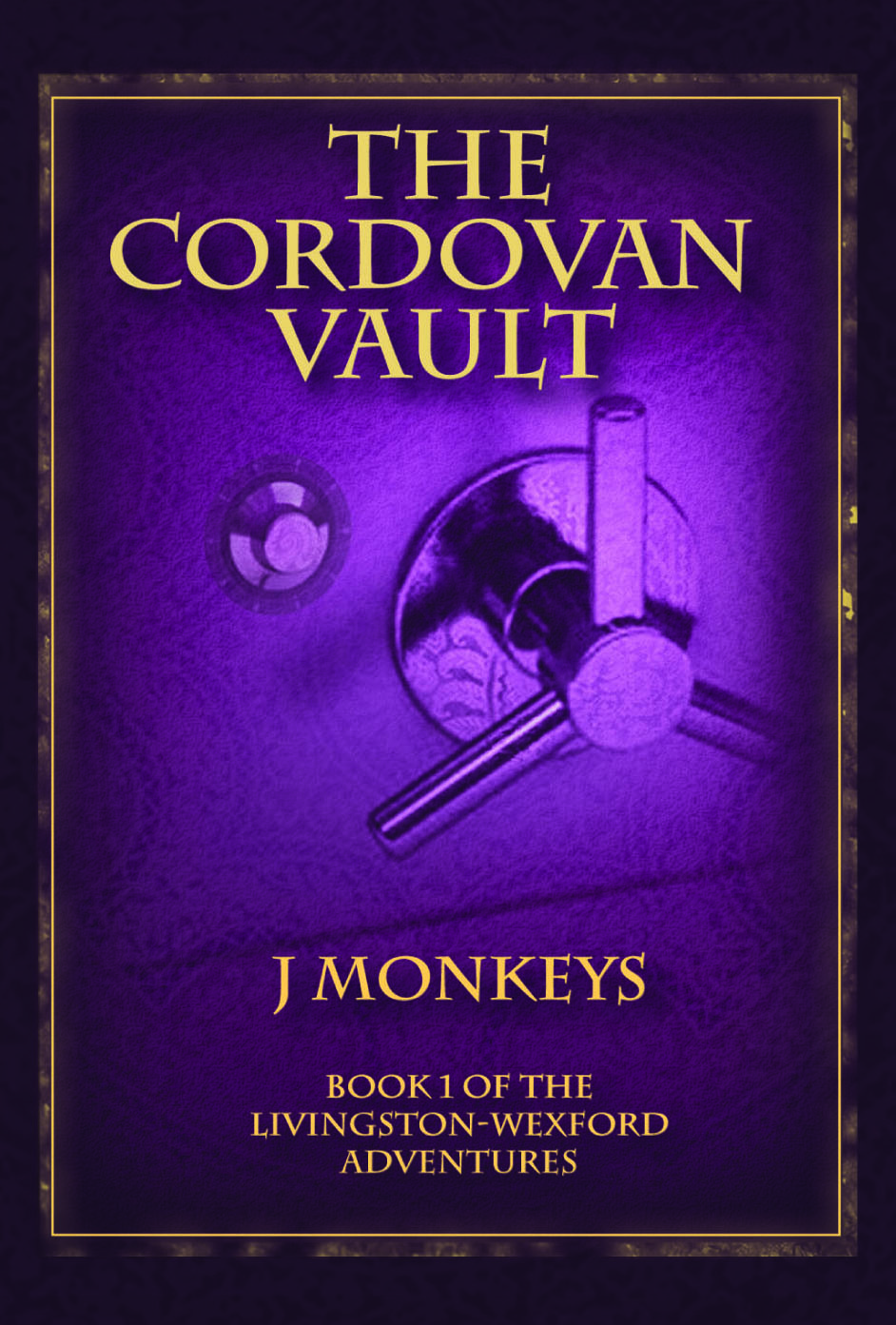
The Cordovan Vault ebook cover smallWhere else can readers find your writings? What’s up next for your writing career?

All of my books are available on Amazon, and my website, of course. I expect to start book three of the Livingston-Wexford Adventures early this summer. I left my characters, 15-year olds Kayla and Quinn, in a bit of a tangle at the end of The Peacock Tale, so it’s time to move that story forward. And I wrote a tragedy as part of the “research” on my fictional pirate, Captain Peacock. I’m planning to revise that and release it as a companion piece. It’s really more of a Young Adult story than it is a Middle Grade adventure.

And I’m super excited about some work I’ve been doing this year. I’ve been working with kids, guiding them through a real-life writing adventure. We create, write, illustrate and edit a book, then publish it through Amazon. I’ve been working with schools and after-school programs, kids from Kindergarten through Fifth Grade. It’s been really fun and rewarding. When I get a minute, I need to update my website (www.jmonkeys.com) with links to their books. I’m starting to book programs for the 2015-16 school year now. There’s a link on my website, if anybody’s interested.

And finally, what is something funny/weird/exceptional about yourself that you don’t normally share with others in an interview?

Something funny. Hmmm. Well, it’s not so much funny “ha-ha” as it is funny “odd.” I have a pretty great vocabulary, but I’m a terrible speller. I mean awful. Like, spell-check can’t figure out what I’m trying to spell. Sometimes I don’t even know where to look in the dictionary to figure it out. And my handwriting is worse than my spelling. I sometimes take a break from the computer and go write by hand somewhere away from my house. Usually, when I get back and type it into the story document, there are at least two words that I can’t figure out, either because I butchered the spelling so badly or they’re simply illegible.

monkey logo finalVisit J Monkeys here:

Author website

The Cordovan Vault

The Peacock Tale

« Older posts Newer posts »

© 2026 Katie L. Carroll

Theme by Anders NorenUp ↑